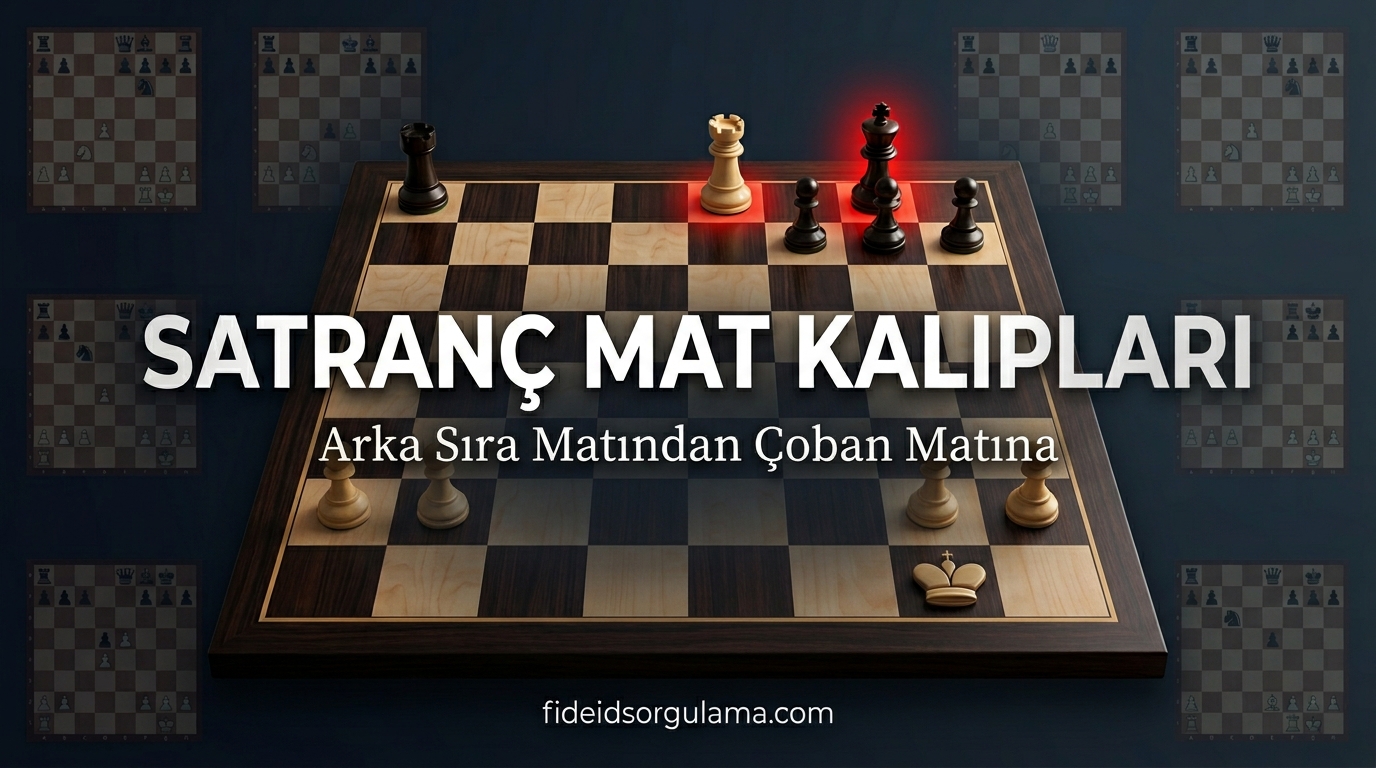
In chess, the ultimate goal is checkmate — threatening the opponent’s king in a way it cannot escape. Throughout history, certain checkmate patterns have appeared again and again and have been given names. Recognizing these patterns helps you spot mating opportunities instantly in your games.
Contents
- What Is Checkmate?
- Back Rank Mate
- Smothered Mate
- Scholar's Mate
- Légal's Mate
- Arabian Mate
- Anastasia's Mate
- Boden's Mate
- Damiano's Mate and the Queen Sacrifice
- Epaulette Mate
- How to Practice Checkmate Patterns
- Frequently Asked Questions
What Is Checkmate?
Checkmate is a position where the king is under attack and cannot be saved by any legal move. Once you are checkmated, the game ends — you lose the point. Checkmate satisfies three conditions at the same time:
- 1. The King Is Under Attack: A piece is directly threatening the king.
- 2. No Escape: There is no safe square the king can move to.
- 3. It Cannot Be Blocked or Captured: No piece can interpose, and the attacking piece cannot be taken.
The Difference Between Checkmate and Stalemate: In stalemate, the king is not in check, but there are no legal moves. Stalemate is a draw, while checkmate is a loss. Knowing this difference is critical, especially in endgames.
1. Back Rank Mate
Back rank mate is the most common mating pattern. The king is boxed in by its own pawns, and a rook or queen delivers mate along the back rank. It appears at every level, even in grandmaster games.
Diagram: Back Rank Mate
White moves the rook from e1 to e8 and checkmates. The Black king cannot escape because its own pawns block the way.
How to Defend Against Back Rank Mate:
- Create luft: Push one of your pawns, usually the h- or g-pawn, one square to give your king an escape square.
- Defend the back rank: Keep your rook or queen controlling the back rank.
- Be careful in exchanges: Always check whether your back rank becomes weak after trades.
2. Smothered Mate
Smothered mate is one of the most elegant mating patterns in chess. The king is completely surrounded by its own pieces, and a knight delivers mate. The knight’s ability to jump into closed positions makes this pattern possible.
Diagram: Smothered Mate
White’s knight on f6 checkmates the Black king on g8. The king is completely surrounded by its own pieces — it is "smothered."
Classic Smothered Mate Combination:
The most famous smothered mate sequence develops like this: first, you sacrifice the queen to force the king into the corner; then, with a double check, you make sure the king is boxed in by its own pieces; finally, the knight delivers mate. This combination, dating back to Philidor in the 18th century, still appears in real games.
3. Scholar's Mate
Scholar's mate is one of the most common mating patterns at beginner level. The queen and bishop work together to attack f7 (or f2) and deliver mate in 4 moves. The f7/f2 squares are the weakest squares in the opening because they are defended only by the king.
Scholar's Mate Move Order
1. e4 e5
2. Bc4 Nc6
3. Qh5 Nf6??
4. Qxf7# (CHECKMATE!)
White’s queen checkmates on f7. The bishop on c4 controls f7, and the queen gives check on f7. The Black king has no escape.
How Do You Defend Against Scholar's Mate?
Instead of allowing the attack, you can play ...g6! to chase away the queen. Or from the start, ...Nf6! both attacks the e4-pawn and defends against Scholar’s Mate. The key is to watch the f7/f2 square. Against experienced players, Scholar’s Mate does not work because bringing out the queen early loses time.
4. Légal's Mate
Légal's mate is a famous mating pattern based on a sacrifice played by Sire de Légal in 1750. While your opponent relies on winning a pinned piece, you sacrifice that pinned piece and deliver mate with three minor pieces.
Classic Légal's Mate Sequence:
1. e4 e5
2. Nf3 d6
3. Bc4 Bg4 (pinning White's knight)
4. Nc3 g6?
5. Nxe5! Bxd1?? (taking the queen, but...)
6. Bxf7+ Ke7
7. Nd5# (CHECKMATE!)
After sacrificing the queen, White checkmates with the bishop on f7, the knight on d5, and the knight on e5 working together. A queen sacrifice for mate — magnificent.
5. Arabian Mate
Arabian mate is a mating pattern carried out by the cooperation of a knight and rook. The knight controls the king’s escape squares while the rook delivers mate. Its name comes from the period when chess passed from the Arab world into Europe.
Diagram: Arabian Mate
White’s rook moves from h6 to h8 and checkmates. The knight controls the king’s escape squares. The king is trapped in the corner.
6. Anastasia's Mate
Anastasia's mate takes its name from the 1803 novel Anastasia and the Game of Chess. It is delivered through the cooperation of a knight and rook; the king is on the edge file, a knight cuts off the escape squares, and the rook gives mate.
Typical Position:
- The Black king is on the h-file, usually after castling
- A White knight on e7 controls g8 and g6
- A White rook delivers mate along the h-file
- Black’s own pawn on g7 prevents the king’s escape
7. Boden's Mate
Boden's mate is a famous mating pattern executed by Samuel Boden in 1858. Two bishops deliver mate together from crossing diagonals. It usually appears in positions where the king has castled queenside and its own pawns obstruct its escape.
Conditions for Boden's Mate:
- The king is usually on c8 or c1, after long castling
- Two bishops control the king and its escape squares from crossing diagonals
- The king’s own pieces, especially a pawn or rook, block its escape
- It is often prepared by a queen sacrifice
8. Damiano's Mate and the Queen Sacrifice
Damiano's mate takes its name from the Portuguese chess writer Pedro Damiano (1512). The queen and pawn, or the queen and rook, work together to mate the king on an edge file. In its most striking form, it begins with a queen sacrifice.
Damiano's Mate Sequence (Typical):
1. Qh7+!! Kxh7 (Queen sacrifice!)
2. Rh5+ Kg8
3. Rh8# (CHECKMATE!)
After sacrificing the queen, White delivers mate on the h-file with doubled rooks. A striking and unforgettable combination.
9. Epaulette Mate
Epaulette mate is a pattern in which the king’s own pieces, usually rooks, stand on both sides of it like shoulder boards, while the queen delivers mate from the front. Its name comes from the epaulettes worn on military uniforms.
Typical Epaulette Mate:
The Black king is on e8, with Black rooks on d8 and f8. White’s queen checkmates from e7 or e6. The king cannot escape because of its own rooks on either side — the "epaulettes."
How to Practice Checkmate Patterns
- Solve mating puzzles
Start with "Mate in 1" and "Mate in 2" puzzles on Lichess and Chess.com. Instead of solving quickly, build the habit of checking all escape squares. - Pattern recognition
Study the patterns in this guide one by one. Once the basic shape of each pattern is fixed in your mind, you will spot similar positions instantly during a game. - Study master games
Look for these mating patterns in grandmaster games. Games by Paul Morphy, Mikhail Tal, and Garry Kasparov are especially rich in mating combinations. - Combine them with tactics
Link mating patterns with tactical motifs. Most mating combinations begin with a fork, pin, or deflection and end with a mating pattern.
Frequently Asked Questions
How many checkmate patterns are there?
There are more than 30 named checkmate patterns. In this guide, we covered the most common and most important ones. Rather than trying to memorize them all, focus on the most frequently seen ones, such as back rank mate, smothered mate, and Scholar's Mate.
Is solving mate-in-1 puzzles useful?
Absolutely. Mate-in-1 puzzles improve your ability to recognize checkmate patterns. Solving them quickly and accurately builds the foundation for more complex combinations. Even 10 to 15 minutes a day can make a big difference.
At what level is back rank mate seen most often?
Back rank mate appears at every level. At beginner and intermediate level, it often appears as a direct checkmate; at advanced level, it often appears as a mating threat that restricts the opponent’s mobility. Even in grandmaster games, back rank themes come up frequently.
Is Scholar's Mate a good opening strategy?
No. Scholar’s Mate only works against inexperienced opponents. If it is defended, White loses time because the queen came out too early and can end up with a bad position. Learning proper opening principles is far more effective.
What exactly is the difference between stalemate and checkmate?
In checkmate, the king is under attack and cannot escape — you lose the game. In stalemate, the king is not under attack, but there is no legal move — it is a draw. To avoid stalemating your opponent in a winning position, make sure their king always has at least one legal move unless you are delivering mate.
How much should you know about mating patterns in the endgame?
In the endgame, you should know at least these basic mates: rook and king vs king, queen and king vs king, and two bishops and king vs king. Without these basic mates, you cannot convert winning positions into a technical win.
Related Content
Comments
Share your thoughts. Comments appear after moderation approval.