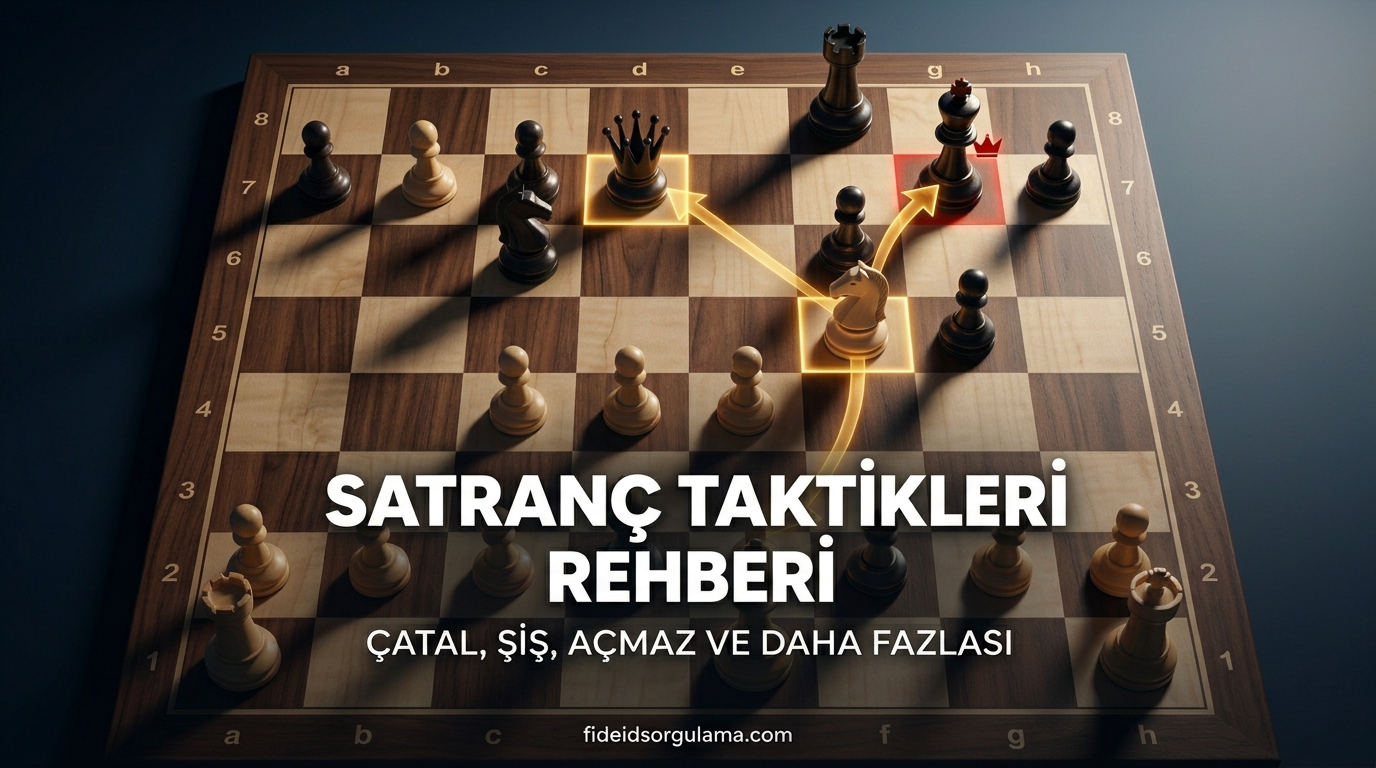
Most chess games are won or lost because of tactical mistakes. While strategy teaches you to find the right plan, tactics allow you to carry out that plan with concrete moves. In this guide, we explain the basic tactical motifs every chess player should know, with illustrated examples.
Table of Contents
- What Is a Tactic?
- Fork
- Skewer
- Pin
- Discovered Attack
- Double Check
- Overloading
- Deflection
- Decoy
- Zwischenzug
- Removing the Defender
- X-Ray Attack
- How to Improve Your Tactical Skills
- Frequently Asked Questions
What Is a Tactic?
Tactics are concrete sequences of moves based on short-term calculation. They aim to gain a material or positional advantage by exploiting a specific weakness in the opponent's position, such as an unprotected piece, an exposed king, or an overloaded piece.
Strategy: Long-term plans and positional principles
Tactics: Short-term calculation and concrete move sequences
As the legendary chess player Richard Teichmann said: "Chess is 99% tactics." Even if that is not literally true, it is a fact that tactical skill is one of the foundations of the game.
The Difference Between Tactics and Combinations:
A tactical motif contains a single theme, such as a fork, skewer, or pin. A combination, on the other hand, is a forcing sequence that brings together multiple tactical motifs and often includes a piece sacrifice.
1. Fork
Fork is when one piece attacks two or more enemy pieces at the same time. Since the opponent can save only one piece with a single move, the other is usually lost.
Which pieces can fork?
- Knight fork: The most classic type of fork. Thanks to its L-shaped movement, the knight creates forks that are hard to defend against. A knight fork attacking the king and queen at the same time (a "family fork") is especially powerful.
- Pawn fork: A pawn attacks two pieces at once by capturing diagonally. Since the pawn has low value, most pawn forks result in a material gain.
- Bishop fork: A bishop can attack two pieces at once along diagonals.
- Rook fork: A rook attacks two pieces on the same rank or file.
- Queen fork: Since the queen moves both diagonally and horizontally/vertically, it creates the most fork opportunities.
Diagram: Knight Fork ("Family Fork")
White's knight on f4 attacks the black king on e2, queen on d3, and rook on h3 at the same time. The king must move, so the queen is lost.
2. Skewer
Skewer is the opposite of a pin: the more valuable piece is in front, and the less valuable piece is behind it. When the valuable piece moves away, the piece behind it is captured. Bishops, rooks, and queens can all deliver skewers.
Types of Skewers:
- Absolute skewer: The king is in front, so it must move and the piece behind it is lost.
- Relative skewer: A valuable piece such as a queen or rook is in front. If it stays, it is captured; if it moves, the piece behind it is captured.
Practical Tip: Skewer opportunities usually appear on open files, ranks, and diagonals. In the endgame, a rook can skewer a king and pawn on the same rank. A bishop is effective on a diagonal against a king with a rook or queen behind it.
3. Pin
Pin is a situation where moving a piece would expose a more valuable piece behind it. The pinned piece either cannot move at all or moving it would lead to a major loss.
Absolute Pin
The pinned piece has the king behind it. Moving the piece is illegal by rule because it would expose the king. This is the strongest type of pin.
Relative Pin
The pinned piece has a valuable piece such as a queen or rook behind it. The piece can move, but doing so leads to serious loss.
Diagram: Absolute Pin with a Bishop
White's bishop on c3 pins the black knight on f6. If the knight moves, it exposes the black king on e8 behind it, so the knight cannot move at all. This is an absolute pin.
4. Discovered Attack
Discovered attack occurs when moving one piece opens an attack line for the piece behind it. If the moving piece also creates a separate threat, the opponent often cannot defend against both attacks at once.
Why Is a Discovered Attack So Strong?
- The moving piece can go to almost any square, because the main attack comes from the piece behind it.
- Two attacks happen at the same time, and the opponent can usually defend only one.
- Many tactical motifs can be combined with a discovered attack, such as discovered attack plus fork or discovered check.
5. Double Check
Double check is the strongest form of a discovered attack: both the moving piece and the piece on the opened line give check at the same time. Against a double check, the only defense is moving the king. You cannot block both attacks, and simply capturing the attacker is not enough because there are two checking pieces.
Why Is Double Check So Deadly?
Normally, there are three ways to respond to check: move the king, block the line, or capture the attacking piece. Against double check, only moving the king works. That is why double check is often part of mating combinations.
6. Overloading
Overloading is a tactical motif in which one piece is responsible for multiple defensive duties at the same time, and fulfilling one of them forces it to abandon another.
How to Spot It:
- Identify an enemy piece that is defending two different squares or pieces.
- Force that piece to carry out one of its duties.
- Exploit the area or piece it can no longer defend.
7. Deflection
Deflection is the tactic of drawing a defending piece away from its critical task. It is similar to overloading, but here the piece is actively lured away from its square.
Example: Black's rook is defending both the back rank and the f7 pawn. White offers a sacrifice that forces the rook away from the back rank, then delivers a back-rank mate.
8. Decoy
Decoy is the tactic of luring an enemy piece to a square it does not want to occupy. You can think of it as the opposite of deflection: with deflection, you drive a piece away; with decoy, you lure it onto a specific square.
Common Decoy Examples:
- Sacrificing a piece to lure the king onto a fork square
- Luring a piece onto a pin line
- Luring the king onto an open rank or diagonal to deliver mate
9. Zwischenzug
Zwischenzug (German: Zwischenzug) is an unexpected in-between move inserted instead of the obvious move. It often comes in the form of a check or another strong threat.
Why Is It So Dangerous?
During an expected exchange, your opponent often goes on autopilot. A zwischenzug disrupts that automatic calculation. Especially during piece exchanges, make it a habit to look for in-between moves.
10. Removing the Defender
Removing the defender is the tactic of eliminating a key defensive piece in order to reach the target it protects. Once the defending piece is removed, the position behind it collapses.
Three Methods:
- Capture: Capture the defending piece directly.
- Exchange: Trade it off, for example with an exchange sacrifice.
- Chase away: Threaten the defending piece and drive it from the critical square.
11. X-Ray Attack
X-ray attack is a hidden attack in which a piece exerts influence through another piece. When the intervening piece moves or is captured, the attack behind it is revealed.
Example: White has a rook on a1, Black has a rook on a4 and a queen on a8. Under normal circumstances, the white rook is "blocked" by the black rook on a4. But if the rook on a4 moves for any reason, the white rook immediately attacks the black queen on a8 directly. That is the X-ray effect.
How to Improve Your Tactical Skills
Improving tactical skill requires regular practice. Here are proven methods:
1. Daily Tactical Puzzles
Solve at least 15-20 puzzles every day on Chess.com, Lichess, or ChessTempo. Accuracy matters more than speed.
2. Motif Recognition
Memorize the motifs in this guide. When you look at a position in a game, ask yourself: "Is there a fork here? Is there a pin?"
3. Game Analysis
Analyze your own games with a chess engine. Identify the tactics you missed and study similar motifs.
4. Calculation Tree
Use the calculation tree to evaluate your moves systematically. Start by calculating forcing moves first: checks, captures, and threats.
Calculation Tip: In every position, first check forcing moves in this order: Check, Capture, Threat. This sequence is one of the most effective ways to avoid missing tactical opportunities.
Frequently Asked Questions
What is the difference between tactics and strategy?
Tactics are short-term concrete calculations, such as forks, pins, and mating threats. Strategy covers long-term plans and principles, such as pawn structure, space advantage, and piece coordination. Tactical skill is the tool that allows you to carry out strategic ideas.
At what ELO level should I start studying tactics?
You can start studying tactics from day one. At beginner level (ELO 800-1200), start with simple one-move tactics. Once you reach intermediate level (1200-1800), move on to 2-3 move combinations. Learn more about the ELO system.
Which appears more often: forks or pins?
Statistically, the pin is the most common tactical motif, because pin situations arise naturally in many positions. However, the tactic that most often wins material is usually the fork, especially knight forks.
My puzzle-solving speed is not improving. What should I do?
Focus on accuracy rather than speed. Before solving a position, identify all candidate moves. Analyze every wrong solution: which motif did you miss? Also make sure to solve puzzles appropriate for your level, because puzzles that are too difficult can hurt motivation.
Is solving tactics online enough, or should I also read books?
Both are valuable. Online platforms offer instant feedback and rating tracking. Books provide deeper understanding and more systematic learning. The ideal method is daily practice with online puzzles combined with deeper study using classic tactics books such as the Yusupov series.
How can I spot tactical opportunities in a game?
Look for these "alarm signals": undefended pieces, a king and valuable piece lined up on the same line, overloaded defenders, a weak back rank, and a poorly placed king. When you see these signs, switch to concrete calculation.
Related Content
Comments
Share your thoughts. Comments appear after moderation approval.