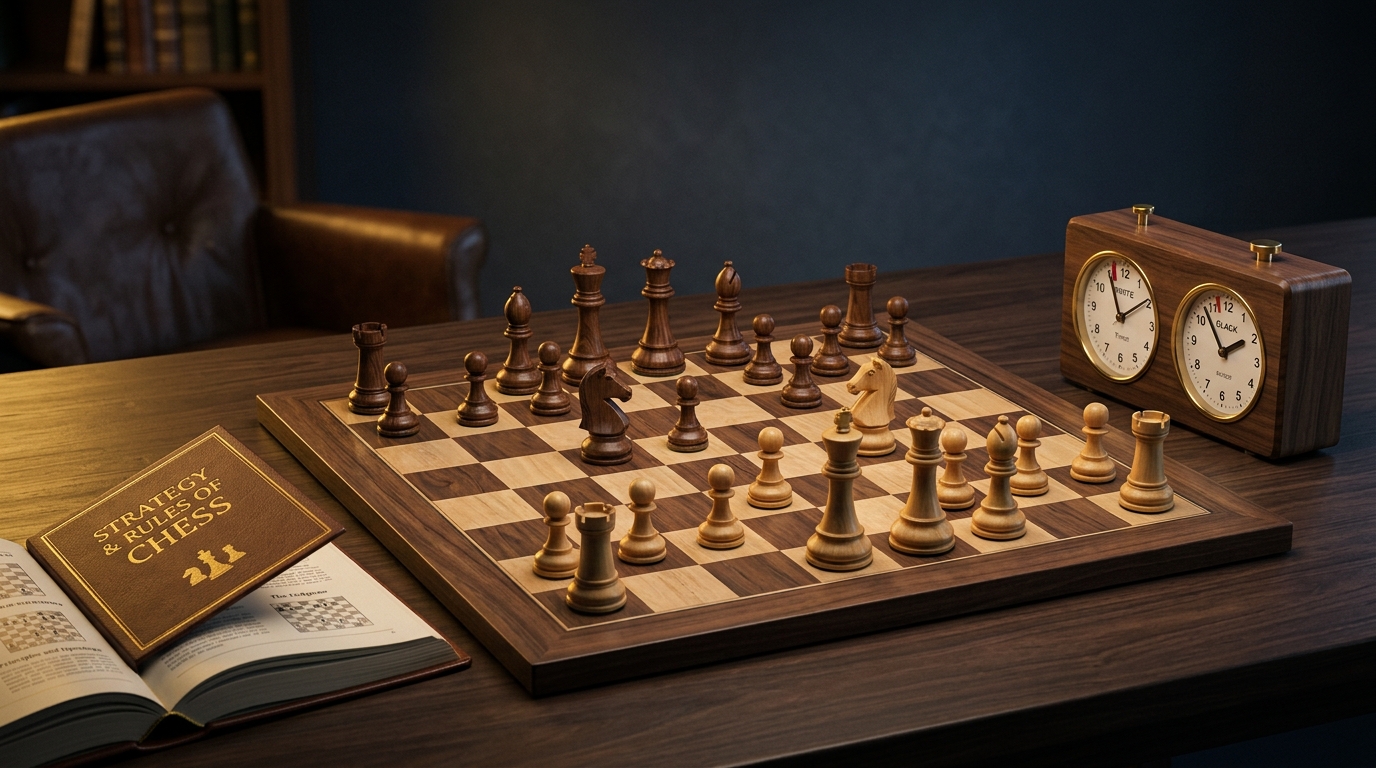
FIDE (World Chess Federation) is the international authority that determines all official rules of chess. In this guide, we explain FIDE's current rules step by step with interactive animations and Turkish chessboard visuals. Whether you are a beginner or someone looking to fill gaps in your understanding of the rules â you are in the right place.
ð About FIDE Rules
This guide is based on the FIDE Laws of Chess (2023) document. The rules are updated rarely; however, always check the organizer's special rules before each tournament.
1. Chessboard and Starting Setup
The chessboard consists of 8Ã8 = 64 squares. The squares are arranged alternately in light (white) and dark (black) colors.
ð Rule for Correctly Placing the Board
Each player must have a light (white) square in the bottom-right corner. To remember this: "Right side is bright!"
â ï¸ Queen rule: The queen is always placed on a square of her own color. White queen â d1 (light square). Black queen â d8 (dark square).
2. Piece Movements
According to FIDE rules, each piece has its own unique way of moving. Below, we examine each piece with detailed visuals and animations.
â King
The king is the most important piece in the game. Being checkmated means the game is over â therefore the king can never be removed from the board.
- It moves only one square in any direction (horizontal, vertical, diagonal).
- It cannot move into squares threatened by the opponent.
- If the adjacent squares are empty and safe, it can castle (explained in a later section).
â Queen
The queen is the most powerful piece on the board. It combines the movements of the rook and bishop.
- It can move an unlimited number of squares horizontally, vertically, and diagonally.
- It cannot jump over other pieces.
- It is worth 9 points.
â Rook
The rook is a long-range and extremely powerful piece. It becomes especially effective in the endgame.
- It moves any number of squares horizontally and vertically.
- It cannot move diagonally.
- It can castle together with the king.
- It is worth 5 points.
â Bishop
The bishop is a long-range piece that moves along diagonals. Each player starts with two bishops: one light-squared bishop and one dark-squared bishop.
- It moves any number of squares diagonally.
- It stays on the same color square throughout the game (it never changes color).
- It cannot jump over other pieces.
- It is worth 3 points.
â Knight
The knight is the most unique piece in chess. It is the only piece that can jump over other pieces.
- It moves in an "L" shape: 2 squares in one direction + 1 square perpendicular (or vice versa).
- As the only piece in chess, it can jump over other pieces.
- With every move, the square color changes (light â dark or vice versa).
- It is worth 3 points.
â Pawn (Pawn)
The pawn is the most numerous piece. Although it looks weak, in the hands of skilled players it has a strategically critical role.
- It moves one square forward (it cannot move backward).
- On its first move, it may optionally advance two squares.
- It can capture an opponent's piece only diagonally (one square forward) â it cannot capture while moving straight ahead.
- When it reaches the last rank, it promotes (to a queen, rook, bishop, or knight).
- It is worth 1 point.
3. Piece Values
Although the FIDE rules do not assign official point values to the pieces, the widely accepted value system is listed as follows:
ð¡ Point Calculation in Exchange Decisions
Giving up a knight or bishop (3 points) in exchange for a rook (5 points) is called winning the exchange (+2 point advantage).
Giving up two minor pieces (knight + bishop = 6 points) in exchange for a queen (9 points) is generally an exchange favorable to the queen.
4. Special Moves
The FIDE rules define three special moves. These moves enrich the game strategically and can come as a surprise to those who do not know them.
ð° Castling (Castling)
Castling is the only special move in which the king and rook move together in the same move. Its main purpose is to bring the king to safety.
Kingside Castling (King Side â O-O)
King: e1 â g1 | Rook: h1 â f1
Queenside Castling (Queen Side â O-O-O)
King: e1 â c1 | Rook: a1 â d1
FIDE's four conditions for castling:
Even if the king or the relevant rook moved earlier and then returned, castling can no longer be done.
For kingside castling, the squares f1 and g1; for queenside castling, the squares b1, c1, and d1 must be empty.
Castling while in check is forbidden. It is not possible to escape check by castling.
The squares the rook passes through may be under attack â this does not prevent castling.
ð¯ En Passant
It is one of the least known special moves in the FIDE rules. It occurs only between pawns.
As a result of this move, it comes next to your pawn (on the 5th rank).
You move your own pawn diagonally forward â the opponent's pawn is removed from the board.
If one move passes, the en passant right is lost completely.
â ï¸ En passant is valid in all FIDE games unless the organizer has an additional rule. Many beginner-level players do not know this â if your opponent does not know it, kindly remind them.
ð Pawn Promotion
When a pawn reaches the last rank of the board, it is mandatory to immediately transform it into another piece.
Promotion options:
- Queen â the most common choice (the strongest piece)
- Rook â rare, but preferred in some endgames
- Bishop â very rare
- Knight â underpromotion; superior to a queen in some mating positions
â Theoretically, you can have 9 queens at the same time (1 original + 8 pawn promotions). FIDE explicitly allows this.
5. Check, Checkmate, and Stalemate
â ï¸ Check
If your king is under threat from an opponent's piece, you are "in check". According to FIDE rules, getting out of check is mandatory â you cannot make any other move.
Three ways to get out of check:
Move the king to a square that is not threatened by an opponent's piece.
Capture the attacking piece with another one of your pieces.
Place a piece between the attacking piece and the king. Note: Blocking is not possible against knight checks, because the knight jumps in an L-shape.
â Checkmate
If your king is under threat and you cannot escape this threat in any way, you are checkmated and lose the game. Double check (if two pieces give check at the same time) can only be defended by moving the king.
ð¤ Stalemate
When it is your turn and you are not in check but you have no legal move you can make, the game ends in a draw. Stalemate is a way out for the side with a material disadvantage.
6. Draw Situations
According to FIDE, a chess game can end in a draw in five different ways:
| Type of Draw | Description |
|---|---|
| Stalemate | The player to move has no legal move and is not in check. |
| Insufficient Material | There are not enough pieces to deliver checkmate (king-king, king-bishop-king, king-knight-king). |
| Threefold Repetition | If the same position (same pieces, same move rights) is repeated three times, the player who claims it may declare a draw. |
| 50-Move Rule | A draw may be claimed if no pawn move or capture has been made in the last 50 moves. |
| Mutual Agreement | Both players agree to a draw. |
ð¡ Claiming Threefold Repetition
According to FIDE rules, the arbiter must be called before the threefold repetition occurs. The 75-move rule, however, provides an automatic draw without requiring an arbiter.
7. Time Control and the Chess Clock
FIDE rules make the use of a chess clock mandatory in all official tournaments.
| Format | Time | Counts for FIDE Rating? |
|---|---|---|
| Classical / Standard | 90 min + 30 sec increment (or longer) | â Yes |
| Rapid | 10 min â 60 min | â Yes (separate list) |
| Blitz | 3 min â 10 min | â Yes (separate list) |
| Bullet | 1 min â 3 min | â No |
â ï¸ A player who runs out of time loses! However, if your opponent does not have sufficient material to deliver checkmate (e.g. only a king remains), the game is declared a draw.
8. Basic Tactical Motifs
After learning the FIDE rules, you begin to think strategically. Here are the 5 most common tactical motifs:
Fork
One piece attacks two or more enemy pieces at the same time. Knight forks are the strongest.
Pin
A piece cannot move, because if it does, the more valuable piece behind it is exposed.
Skewer
You attack a valuable piece; when it moves away, you capture the less valuable piece behind it.
Discovered Attack
By moving one piece, you open the line of attack of the piece behind it â creating a double threat.
Double Check
Two pieces give check at the same time. To escape this situation, the king must move.
9. Chess Notation
In FIDE tournaments, recording all moves in algebraic notation is mandatory.
| Symbol | Meaning | Example |
|---|---|---|
| K | King | Ke2 |
| Q | Queen | Qd5 |
| R | Rook | Rd1 |
| B | Bishop | Bc4 |
| N | Knight | Nf3 |
| (no letter) | Pawn | e4 |
| x | Capture | Bxf7 |
| + | Check | Qd8+ |
| # | Checkmate | Qf7# |
| O-O | Kingside castling | Kingside |
| O-O-O | Queenside castling | Queenside |
10. FIDE Tournament Rules and Conduct
ð± Mobile Phone Rule
According to FIDE's zero tolerance rule, if a mobile phone rings in the tournament hall, the player automatically loses. The phone must be turned off or left in the car.
â "Touch-Move" Rule
If you touch your own piece while your opponent's clock is running, you must move that piece (if there is a legal move). If you touch your opponent's piece, you must capture that piece (if possible).
ð Mandatory Move Recording
In classical tournaments, all players are required to record both sides' moves on the scoresheet. This requirement is waived if both players have less than 5 minutes remaining on their clocks.
â ï¸ According to FIDE rules, the arbiter's decision is final. Treating the arbiter politely and respectfully is part of professional conduct.
Conclusion: What Should Your Next Step Be?
You have learned FIDE's official chess rules with animations and visuals. Now it's time to use this knowledge in real games!
- Get a FIDE ID: Read our guide How to get a FIDE ID?.
- Learn your ELO rating: Check out our ELO rating calculation guide.
- Join a tournament: Find a FIDE-rated tournament that suits you in the TSF calendar.
- Track your rating: Follow your FIDE profile via fideidsorgulama.com.
This guide is up to date as of 2026. For the full FIDE Laws of Chess document, you can visit fide.com.
Comments
Share your thoughts. Comments appear after moderation approval.