

The Berger system is the standard pairing method used in round-robin chess tournaments. In the FIDE Handbook it appears as the Berger Table and defines who plays whom in each round and how the color flow is balanced.
What Is the Berger System?
Round robin is the event format; the Berger table is the round-by-round blueprint that runs it. Players receive starting numbers, the correct table is selected, and the pairings are taken from that structure. No opponent is repeated within a cycle, and a single round robin with N players finishes in N-1 rounds.

How Do You Read a Berger Table?
Each row is a round and each pair is a board assignment. In the standard 8-player FIDE sequence, the first round begins with 1-8, 2-7, 3-6, 4-5. Then the numbers rotate to generate the next opponents.
Single and Double Round Robin
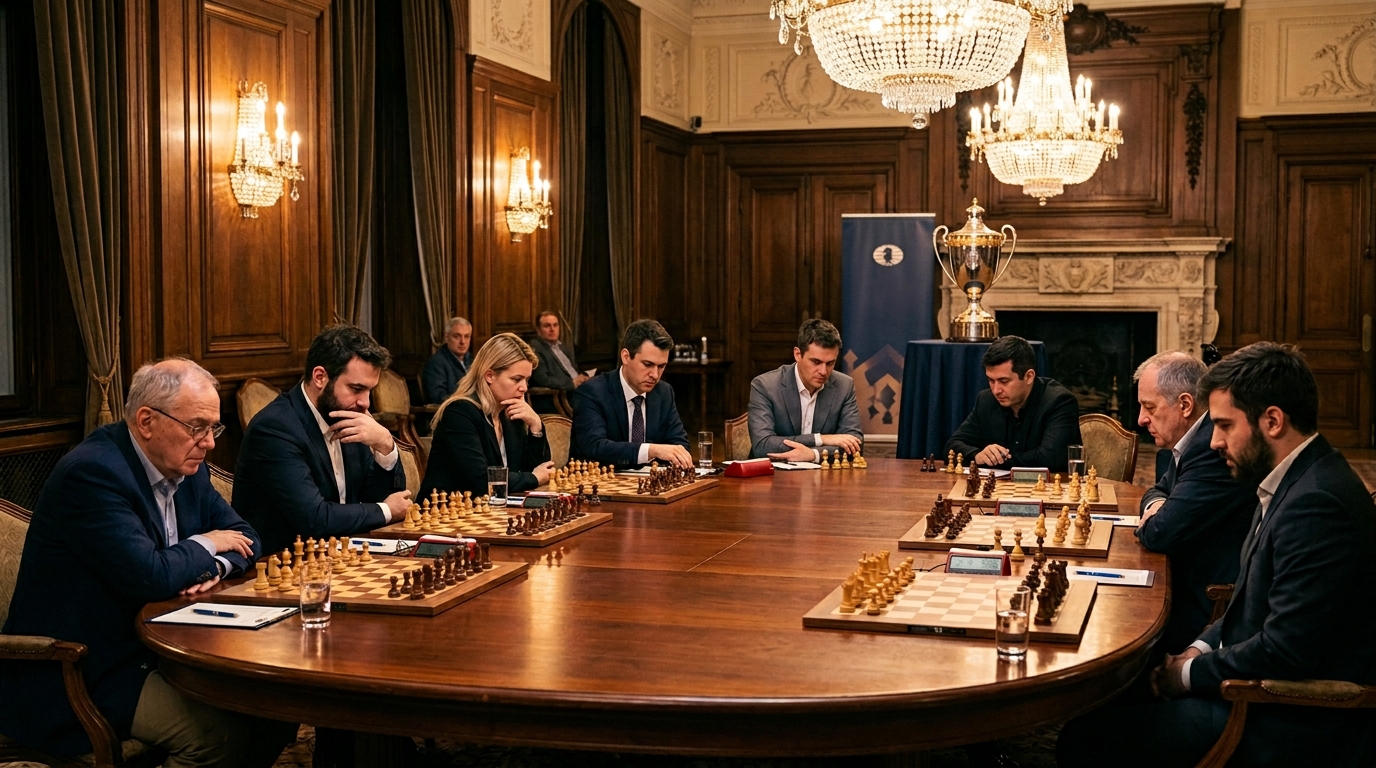
In a single round robin, each opponent is faced once. In a double round robin, each pairing is repeated with colors reversed. For 8 players that means 7 rounds in a single cycle and 14 rounds in a double cycle. The FIDE Candidates Tournament 2026 is a current official example of the double-round-robin format.
Odd Number of Players and Byes
If the field has an odd number of players, the system adds a virtual extra number and the highest number acts as the bye. In a 7-player event, for example, the 8-player table is used and whoever is paired with number 8 sits out that round.
Why Does Color Balance Matter?
The Berger system is not only about opponents but also about color balance. In a double round robin, colors are reversed in the second cycle. FIDE also notes that switching the order of the last two rounds in the first cycle helps avoid three consecutive games with the same color.

Crosstables and Sonneborn-Berger
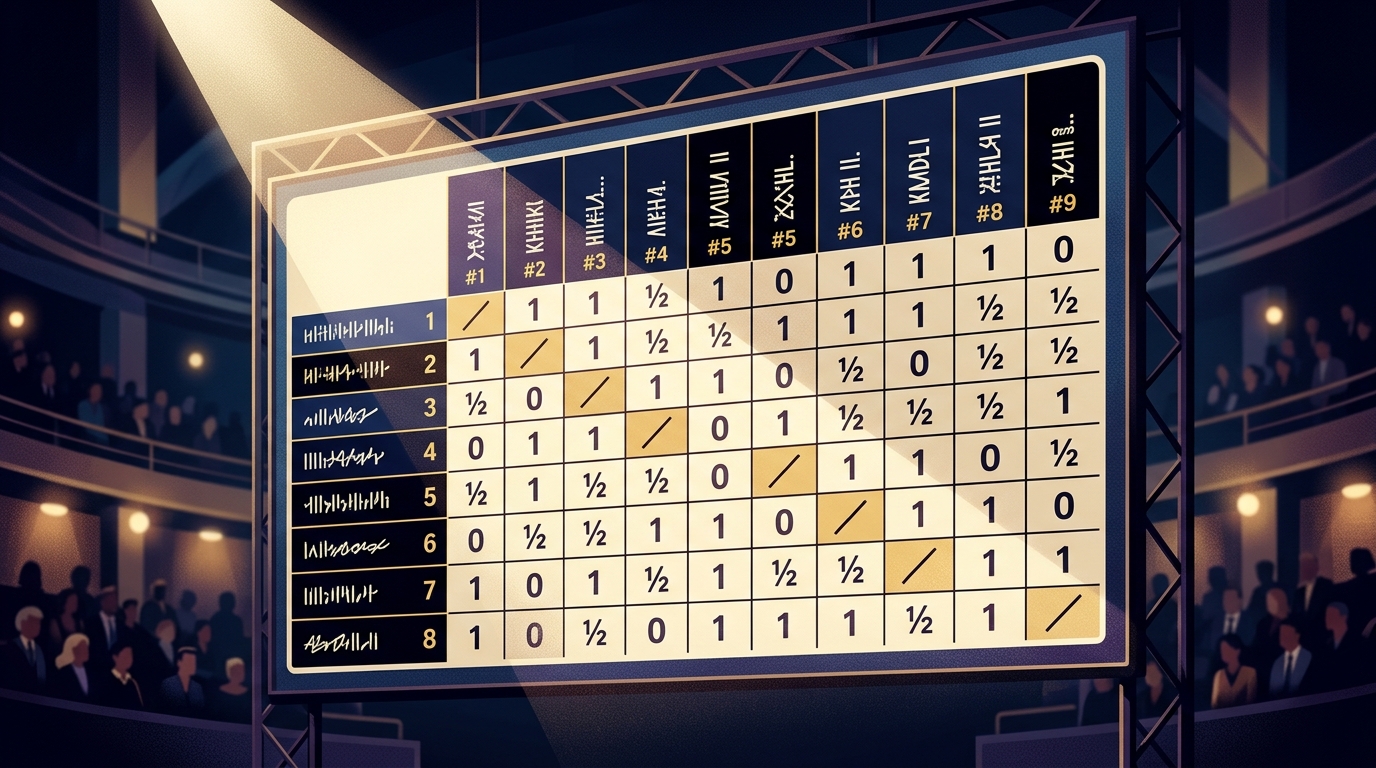
The natural result document for a round robin is the crosstable. It shows direct encounters, final scores and tie-break inputs. The Berger system should not be confused with Sonneborn-Berger: Berger creates the pairings, while Sonneborn-Berger is a tie-break method used after the games are finished.
Berger or Swiss?
Berger is ideal for small closed groups. For larger opens, the Swiss system is much more practical because a full round robin becomes too long. Berger optimizes fairness in small fields, while Swiss optimizes scale.
Conclusion
The Berger system remains the cleanest classical way to run a small round-robin chess tournament. It gives clear opponent distribution, workable bye handling, balanced colors and an easy-to-read crosstable structure.
This guide reflects the FIDE Handbook Annex 1, the FIDE tie-break regulations and the official FIDE Candidates Tournament 2026 regulations as checked in April 2026.
Comments
Share your thoughts. Comments appear after moderation approval.