The vast majority of chess tournaments are organized using the Swiss system. Whether a tournament has 20, 200, or 2,000 players, the Swiss system allows all participants to be ranked in a reasonable number of rounds. So what is the Swiss system, how does pairing work, and how many rounds should be played? In this guide, we explain all the details for arbiters, tournament organizers, and players.
What Is the Swiss System?
The Swiss system is a pairing method used in tournaments with a large number of participants. It was first used in 1895 at a tournament in Zurich, Switzerland, and was developed by Dr. Julius Müller.
The fundamental principle is: In each round, players with similar scores are paired against each other, and no player faces the same opponent twice. Unlike elimination tournaments, no player is knocked out — everyone plays all rounds.
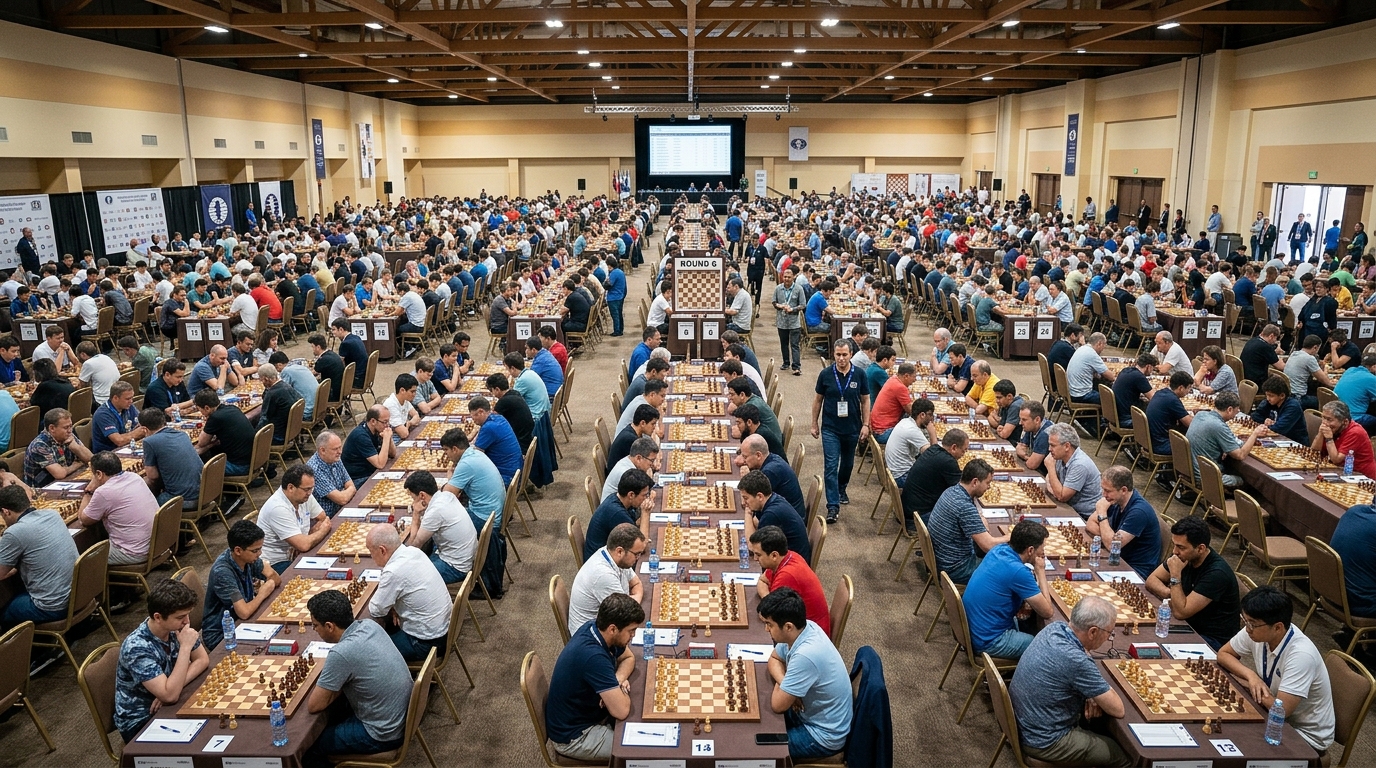
How Does the Swiss System Work?
Round 1 — Initial Pairing
Players are sorted by rating and divided into two halves. The top half is paired against the bottom half. For example, in a 20-player tournament, player 1 faces player 11, player 2 faces player 12, and so on.
Round 2 and Beyond — Score-Based Pairing
From the second round onward, players are grouped by score groups. Players with the same score are paired against each other. If a score group has an odd number of players, one player "floats" down to the next score group.
Basic Pairing Rules
- No repeat opponents: Two players can meet at most once during the tournament.
- Color balancing: Each player should receive as equal a number of white and black games as possible. No more than 2 consecutive games with the same color.
- Score group priority: Pairings are made within the same score group whenever possible.
- Rating order: Within a score group, players are split into upper and lower halves by rating, and upper-half players are paired with lower-half players.

Pairing Systems: Dutch and Baku
FIDE approves two main Swiss system pairing algorithms:
| Feature | Dutch System | Baku System |
|---|---|---|
| Developer | Geurt Gijssen (Netherlands) | FIDE (Baku meeting) |
| Software | Swiss-Manager, Swiss-Master | Vega, other programs |
| Usage | Most widely used worldwide | Some regional tournaments |
| Color balance | Strict balancing rules | More flexible color assignment |
How to Calculate the Number of Rounds?
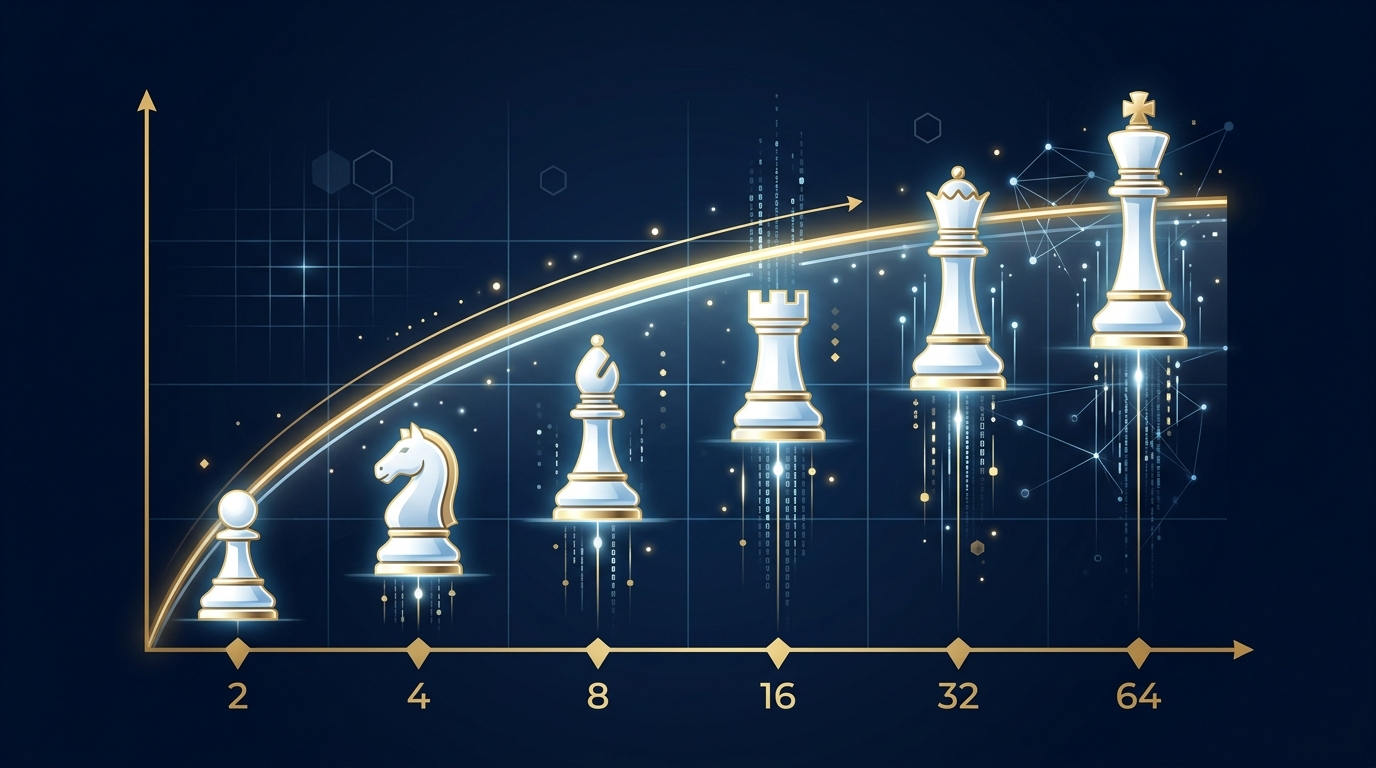
The optimal number of rounds in a Swiss system is found by rounding up the base-2 logarithm of the number of players:
| Players | Minimum Rounds | Recommended Rounds |
|---|---|---|
| 8-16 | 4 | 5-7 |
| 17-32 | 5 | 6-7 |
| 33-64 | 6 | 7-9 |
| 65-128 | 7 | 7-9 |
| 129-256 | 8 | 9-11 |
| 257-512 | 9 | 9-11 |
Bye Rules
When an odd number of players participate, one player cannot be paired each round and receives a bye:
- Full-point bye: The unpaired player receives 1 point (most common).
- Half-point bye: In some tournaments, players may request this in advance (usually except for the last rounds).
- Bye assignment: Typically given to the lowest-scoring, lowest-rated player. A player who already received a bye will not get another one.
Advantages of the Swiss System
- Large player count: Even tournaments with 1,000+ players can be completed in 11-13 rounds.
- No elimination: All players continue playing throughout the tournament.
- Reasonable duration: Much shorter than round-robin. A 100-player round-robin requires 99 rounds; Swiss needs only 7-9.
- FIDE rated: Swiss system tournaments are suitable for FIDE rating calculation.
- Flexibility: Players of all levels can participate and have meaningful games.
Disadvantages of the Swiss System
- Pairing complexity: Manual pairing is very difficult; software (Swiss-Manager, Vega, etc.) is essentially required.
- Ranking uncertainty: Many players may finish with the same score — tie-break methods must be used.
- First-round disadvantage: Lower-rated players are paired against higher-rated players in round 1.
- Last-round draw risk: Leading players may agree to a draw in the final round to share first place.
Swiss System vs. Round Robin: Which to Choose?
| Criteria | Swiss System | Round Robin |
|---|---|---|
| Player count | 10+ (ideal: 20-1000+) | 4-14 (ideal: 6-10) |
| Rounds | log₂(N) + a few extra | N-1 rounds (all-play-all) |
| Fairness | Good (tie-breaks needed) | Most fair (everyone plays everyone) |
| Duration | Short | Long |
| Usage | Open tournaments, festivals | Championships, closed tournaments |
FIDE Swiss System Rules
FIDE has established detailed rules for the Swiss system. Key principles from FIDE Handbook C.04:
- Absolute criterion: Two players can meet at most once during the tournament.
- Score group criterion: Pairings are made within the same score group whenever possible.
- Color distribution: Each player should receive an equal number of whites and blacks. Three consecutive games with the same color is forbidden.
- Color preference: A player who had black in the previous round gets priority for white.
- Upper/lower half pairing: Players in the same score group are split by rating into two halves, and upper-half players are paired with lower-half players.
Practical Tips for Arbiters
- Use software: Use FIDE-approved software like Swiss-Manager or Vega. Manual pairing is not practical for 20+ player tournaments.
- Prepare TRF files: Create the Tournament Report File (TRF) in the correct format for uploading to Chess-Results and reporting to FIDE.
- Handle late entries: Include late registrants by giving them a bye in round 1 or pairing them directly.
- Process withdrawals correctly: Award 0 points for remaining rounds. Mark withdrawn players as "bye" in pairings.
- Enter results quickly: Enter results promptly after each round — the next round cannot be paired until all results are entered.
Creating a Tournament with Swiss-Manager
Swiss-Manager is the most widely used FIDE-approved tournament software worldwide. Basic steps:
- Create a new tournament: Set the tournament name, dates, number of rounds, time control, and pairing system (Dutch/Baku).
- Load the player list: For FIDE-rated tournaments, import the player list from the FIDE database or use fideidsorgulama.com for bulk FIDE ID matching.
- Make pairings: The software generates automatic pairings. You can make manual corrections if needed.
- Enter results: Enter match results after each round.
- Generate reports: Create TRF files, standings, and upload files for Chess-Results.
Frequently Asked Questions (FAQ)
What is the difference between the Swiss system and elimination?
In an elimination (knockout) system, the losing player is removed from the tournament. In the Swiss system, the losing player continues to play in subsequent rounds and is paired with players on the same score. This makes the Swiss system much more inclusive.
How many rounds should a Swiss system tournament have?
The minimum number of rounds is calculated using the log₂(N) formula. For example, 100 players require a minimum of 7 rounds. However, 9 rounds are typically played for fairer rankings. FIDE-rated tournaments should have at least 5 rounds.
What happens if a player withdraws from the tournament?
The withdrawn player's remaining rounds are scored as 0 points. Opponents' scores are not affected, but Buchholz tie-break calculations use the withdrawn player's score, which can negatively impact opponents' Buchholz.
What is the minimum number of players for a FIDE-rated tournament?
There is no minimum player count, but at least 3 FIDE-rated players must participate, and the tournament must be directed by a FIDE-licensed arbiter.
How are first-round pairings made?
Players are sorted by rating and divided into two equal groups. Player 1 (highest rating) is paired with player N/2+1. Unrated players are listed alphabetically.
Is the Swiss system used in online tournaments?
Yes, except for arena-style tournaments on Chess.com and Lichess, most online FIDE-rated tournaments use the Swiss system with the same software (Swiss-Manager, Tornelo, etc.).
Conclusion
The Swiss system is the essential pairing method for chess tournaments. It allows a large number of players to be fairly ranked in a small number of rounds. Understanding the basic principles, round calculation, and pairing rules is essential for arbiters and tournament organizers.
To prepare your player list and match FIDE IDs before a tournament, use the fideidsorgulama.com tool. To check results after the tournament, visit Chess-Results.
This guide is current as of 2026. For the latest FIDE pairing rules, refer to the FIDE Handbook.
Comments
Share your thoughts. Comments appear after moderation approval.