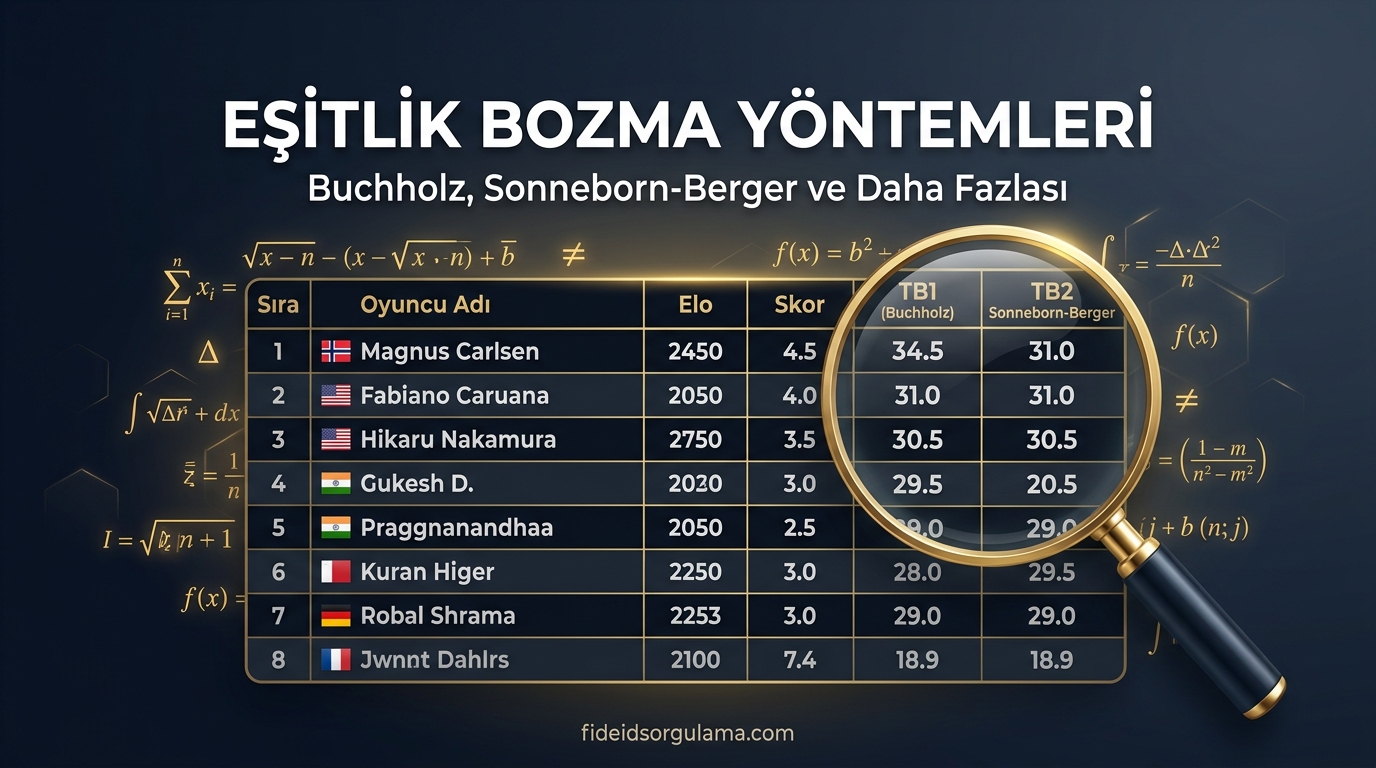
When multiple players finish a chess tournament with the same score, how is the ranking determined? This is where tie-break methods come into play. Buchholz, Sonneborn-Berger, and Median Buchholz are terms frequently encountered but not always fully understood by arbiters and players. In this guide, we explain all tie-break methods with examples.
What Is Tie-Break?
Especially in Swiss system tournaments, it is very common for multiple players to finish with the same score. Tie-break criteria are used to determine the ranking among these players.
FIDE requires tournament organizers to announce the tie-break methods before the tournament begins. These methods are applied in priority order — if the first criterion cannot resolve the tie, the second is used, and so on.
What Is Buchholz Score?
The Buchholz score (Buchholz Sum) is the most commonly used tie-break method in Swiss system tournaments. It was developed by German mathematician Bruno Buchholz.
How Is It Calculated?
It's not about how many points you scored, but how many points your opponents scored. A player who faced stronger opponents will have a higher Buchholz score.
Example Calculation
In a 7-round tournament, Player A and Player B both finish with 5 points:
| Round | Player A's Opponent | Opp. Score | Player B's Opponent | Opp. Score |
|---|---|---|---|---|
| 1 | Opp 1 | 4.5 | Opp 8 | 3.0 |
| 2 | Opp 2 | 5.0 | Opp 9 | 4.0 |
| 3 | Opp 3 | 4.0 | Opp 10 | 4.5 |
| 4 | Opp 4 | 5.5 | Opp 11 | 3.5 |
| 5 | Opp 5 | 3.5 | Opp 12 | 5.0 |
| 6 | Opp 6 | 4.5 | Opp 13 | 4.0 |
| 7 | Opp 7 | 4.0 | Opp 14 | 4.5 |
Player A's Buchholz is 31.0 and Player B's is 28.5, so Player A takes the higher position. Player A faced stronger opponents, indicating their score is more "valuable."
Buchholz Variations
1. Buchholz Cut (Cut 1 / Cut 2)
Buchholz calculated by removing the lowest-scoring 1 or 2 opponents.
Buchholz Cut 2 = Buchholz - two lowest opponents' scores
Why cut? Being paired against a weak opponent in round 1, or an opponent withdrawing early, can unfairly lower your Buchholz. Cutting removes the effect of such outliers.
2. Median Buchholz
Calculated by removing both the highest and lowest scoring opponent(s). This cleans outliers from both ends.
3. Buchholz Total (Sum of Buchholz)
The sum of your opponents' Buchholz scores. This is a second-order Buchholz that considers the strength of your opponents' opponents.

What Is Sonneborn-Berger (SB)?
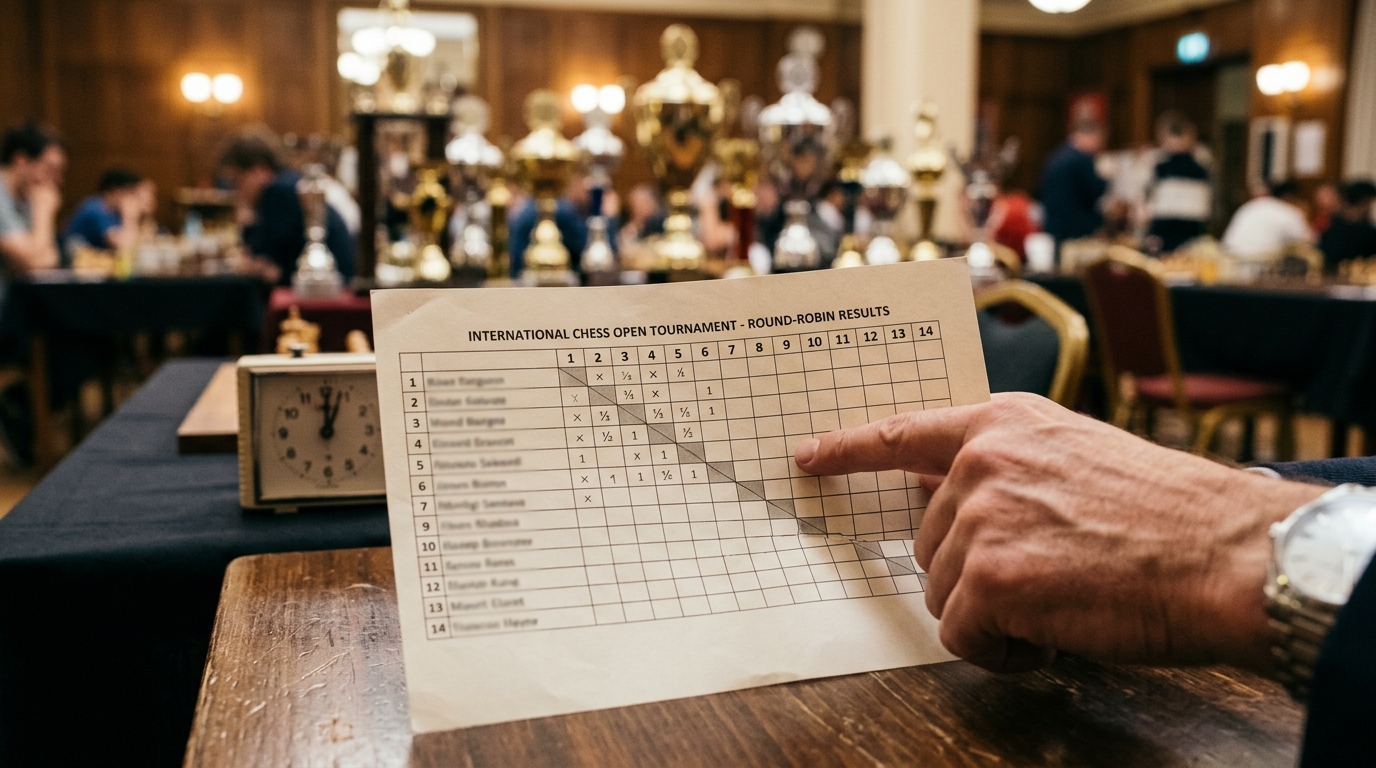
Sonneborn-Berger (SB) is a tie-break method primarily used in Round Robin (all-play-all) tournaments, though it can also be applied in Swiss system events.
How Is It Calculated?
Scores of opponents you lost to are not counted.
Example
A player scores 5 points in 7 rounds: 4 wins, 2 draws, 1 loss.
- Defeated 4 opponents' scores: 4.0 + 3.5 + 4.5 + 3.0 = 15.0
- Drawn 2 opponents' scores: 5.0 + 4.5 = 9.5 x 0.5 = 4.75
- Lost opponent's score: not counted
- SB = 15.0 + 4.75 = 19.75
Interpretation: SB rewards defeating strong opponents and drawing against strong opponents. Beating weak opponents carries less value.
Other Tie-Break Methods
Direct Encounter
If tied players met during the tournament, their head-to-head result is decisive.
- Advantage: The most direct and fair method.
- Disadvantage: In Swiss systems, tied players may not have faced each other. With 3+ tied players, a mini group ranking is calculated.
Cumulative Score (Koya System)
The sum of a player's cumulative (running) scores after each round.
Example: A player with results W-W-L-W-D over 5 rounds:
- After Rd 1: 1, After Rd 2: 2, After Rd 3: 2 (loss), After Rd 4: 3, After Rd 5: 3.5
- Cumulative = 1 + 2 + 2 + 3 + 3.5 = 11.5
A player with the same 3.5 points but results W-L-W-W-D:
- Cumulative = 1 + 1 + 2 + 3 + 3.5 = 10.5
Interpretation: Cumulative score rewards players who win early. Recovering late is less valuable.
Number of Wins
The simplest tie-break: the player with more wins ranks higher.
- 4 wins + 2 draws + 1 loss (5 pts) = 4 wins
- 3 wins + 4 draws + 0 losses (5 pts) = 3 wins
- First player ranks higher due to more wins.
Wins with Black
Winning with black pieces is harder (white has the first-move advantage). Therefore, more wins with black indicates superior performance.
Average Rating of Opponents (ARO)
The average rating of all opponents faced. A player who faced higher-rated opponents ranks higher.
Tournament Performance Rating (TPR)
A theoretical rating value calculated based on tournament performance. Higher TPR indicates a better tournament.
FIDE Recommended Tie-Break Order
For Swiss System Tournaments
| Priority | Method | Description |
|---|---|---|
| 1 | Buchholz Cut 1 | Buchholz minus lowest opponent |
| 2 | Buchholz | Sum of all opponents' scores |
| 3 | Sonneborn-Berger | Defeated + drawn opponents' scores |
| 4 | Direct Encounter | Head-to-head result |
| 5 | Number of Wins | Total number of victories |
For Round Robin Tournaments
| Priority | Method |
|---|---|
| 1 | Direct Encounter (Head-to-head result) |
| 2 | Sonneborn-Berger |
| 3 | Number of Wins |
| 4 | Cumulative Score |
Factors Affecting Buchholz
- Opponent withdrawals: If an opponent withdraws, their low score negatively affects your Buchholz. FIDE rules allow "virtual scores" for withdrawn players.
- Bye effect: An opponent who received a bye may have a lower score, reducing your Buchholz.
- First-round pairing: Being paired against a low-rated opponent in round 1 can negatively impact your Buchholz.
- Forfeits: A forfeited opponent gets 0 points, but FIDE rules allow virtual correction in Buchholz calculations.
Tie-Break and Swiss-Manager
Swiss-Manager software automatically calculates all tie-break methods. In tournament settings:
- When creating the tournament, select tie-break methods and their priority order.
- Default order is typically: Buchholz Cut 1 → Buchholz → SB → Direct Encounter.
- For special tournaments (prize distribution, title norms), different tie-break criteria may apply.
- Clearly state tie-break criteria in the tournament announcement.
Practical Tips for Arbiters
- Announce beforehand: Specify tie-break methods in the tournament regulations. This is a FIDE requirement.
- Track withdrawals: Explain the impact of opponent withdrawals on Buchholz to players. Apply FIDE virtual score rules when necessary.
- Prize distribution: In some tournaments, tie-break is only for ranking and prizes are shared. Decide this in advance.
- Title norm tournaments: Tie-break is not used for title norm calculations — norms are based on performance rating.
Frequently Asked Questions (FAQ)
Why is my Buchholz score low?
Your Buchholz depends on your opponents' performance. If your opponents had a poor tournament, your Buchholz drops. An opponent's withdrawal or forfeit also negatively impacts your Buchholz.
What is the difference between Buchholz and Sonneborn-Berger?
Buchholz sums all opponents' scores regardless of your result. Sonneborn-Berger only counts opponents you defeated or drew with. SB rewards the quality of your victories.
When are tie-break methods applied?
They are applied when players finish with equal scores. Used for ranking, prize distribution, and sometimes determining who advances to elimination rounds. They can also be used for in-round pairing order.
As a player, how can I improve my Buchholz score?
You cannot directly control your Buchholz since it depends on your opponents' performance. However, scoring highly throughout the tournament indirectly improves your Buchholz, as top players face stronger opponents.
Are prizes shared when tie-break is used?
This depends entirely on tournament rules. Some tournaments use tie-break to determine the winner, while others share prizes among tied players. In major tournaments, tiebreak games (rapid, blitz, armageddon) may be played.
Conclusion
Tie-break methods are critical for fair tournament outcomes. Buchholz and its variations are the most commonly used in Swiss system tournaments, while Sonneborn-Berger is preferred in Round Robin events.
For arbiters, correctly applying these methods is essential. For players, understanding how results are interpreted is valuable. Clearly establishing and announcing tie-break criteria before the tournament prevents post-event disputes.
Check your tournament results and opponent information at fideidsorgulama.com, and read our Swiss System Guide for more about tournament formats.
This guide is prepared in accordance with 2026 FIDE rules. For current rules, refer to FIDE Handbook section C.04.
Comments
Share your thoughts. Comments appear after moderation approval.